The end of luck: why every organisation now needs detection and response
Andreessen Horowitz recently published a chart every board should see, first in its newsletter and then on X. Built on Epoch AI data from 21 major software vendors, including Apple, AWS, Microsoft, Google, Nvidia and SAP, it shows critical vulnerabilities staying below 100 a month for four years. Since spring 2026 they have climbed past 600 a month, and high-severity vulnerabilities have passed 2,000.
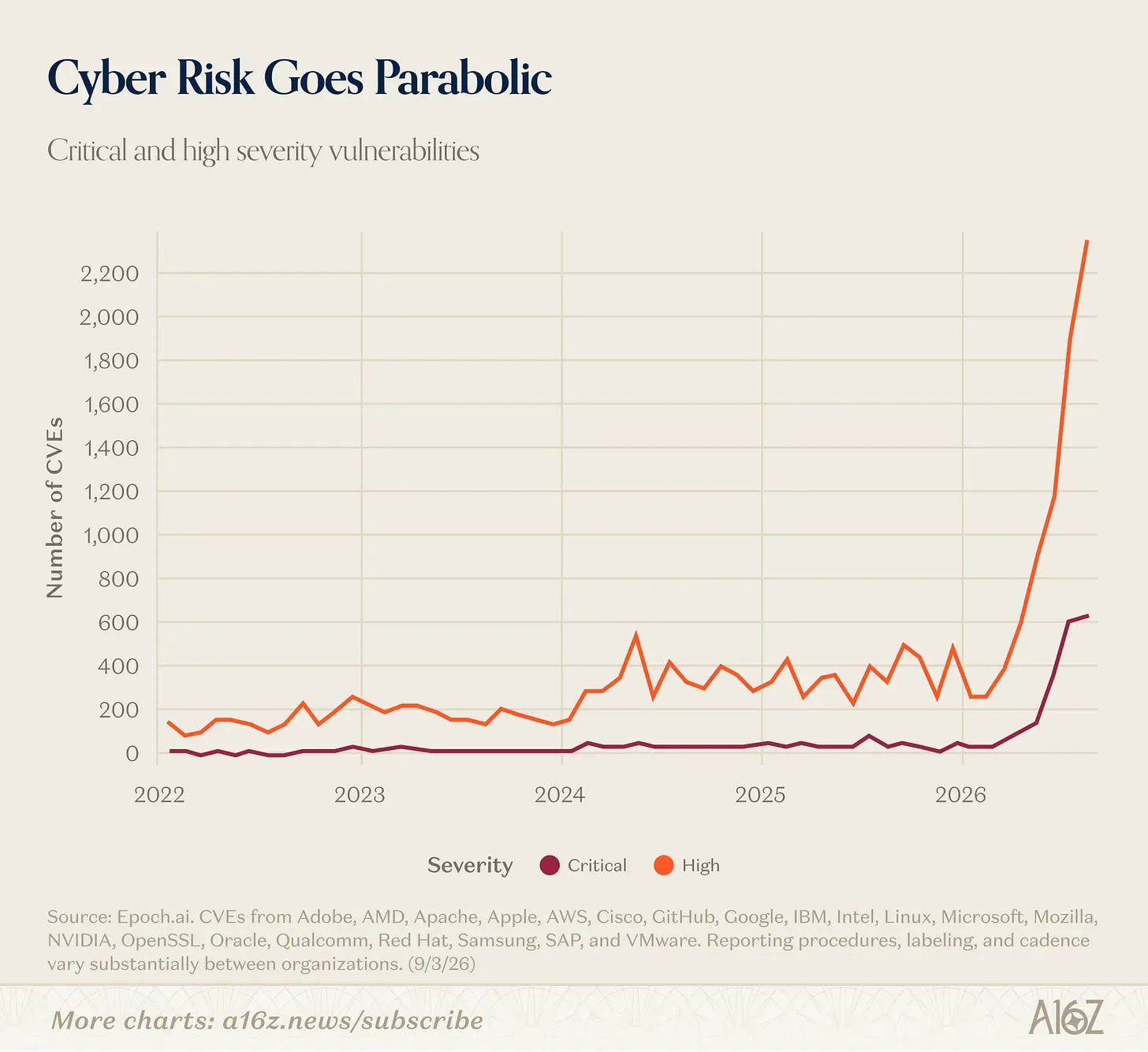
Critical and high-severity vulnerabilities per month. Chart: a16z, data: Epoch AI.
Epoch AI rightly cautions that vendors report, label and time their disclosures differently. But the direction is not in doubt, and it matches what we see in our own work at Secunor. The real question is what this curve means for organisations that have to defend their assets.
AI is surfacing a backlog we always had
In just the past few weeks, we have watched AI-assisted analysis uncover far more vulnerabilities than we could previously find in the same time. That is not because software suddenly got worse. The flaws were always there, waiting for someone with enough time and patience to look.
AI supplies that time and patience at machine scale. Open-source software is the easiest target: its code is public, so AI can read it line by line rather than probe it from the outside. Researchers and attackers alike now find exploitable flaws, and build working exploits for them, in a fraction of the time it used to take.
That puts enormous strain on vendors and maintainers. They must triage and fix far more flaws in far less time, and many open-source projects rely on a handful of volunteers. Every day between disclosure and a patch is a day attackers can use.
So the parabolic curve is largely a backlog coming to the surface, all at once. Years of latent risk are turning into known, exploitable weaknesses in a matter of months. And attackers have access to the same tools.
…while we refill it with software nobody will maintain
At the same time, AI is helping us produce more software than ever before. Internal tools, scripts, integrations and whole applications now get built in days, often by people who would never previously have shipped production code.
Much of this software will never be maintained. It is more likely to be written by less experienced engineers, and it tends to have a short life expectancy. Short-lived code attracts little maintenance effort, yet it rarely disappears on schedule. It lingers on a server or in a cloud account, still exposed, long after its author has moved on.
We are surfacing an old problem and creating a new one in the same breath. AI is helping clear today’s vulnerability backlog, and AI is writing tomorrow’s.
Ten years ago, luck was a reasonable bet
Ten years ago, you could argue that most organisations had a very good chance of going a decade without spending anything on cybersecurity, and without experiencing a single incident. It was never wise, but the odds often supported it.
The exception was organisations holding high-value information: obvious targets for espionage and state actors. They could not afford to play those odds. Worse, they could not even tell whether they had lost the bet.
Financially motivated, opportunistic attacks such as ransomware are noisy by design. The attacker needs you to notice in order to get paid. Espionage is the opposite: success means never being seen. A spy in your network does not send a ransom note.
For these mature, obvious targets, the main reason to invest in security monitoring and proactive work was to close the gap in not knowing. Assume you have been breached, then go and look for the evidence.
In the AI era, assume breach applies to everyone
That logic is no longer limited to a small group of high-value targets. When hundreds of critical vulnerabilities surface every month, and attackers use the same AI tools to find and exploit them, every exposed system is within reach. Opportunistic attackers do not need to choose you. They only need to find something you run.
Patching remains essential, but it can no longer keep pace on its own. ZeroDayClock data, charted by a16z, shows that almost 87% of vulnerabilities exploited in 2026 were exploited on or before the day they were disclosed. In 2018 the figure was under 19%.
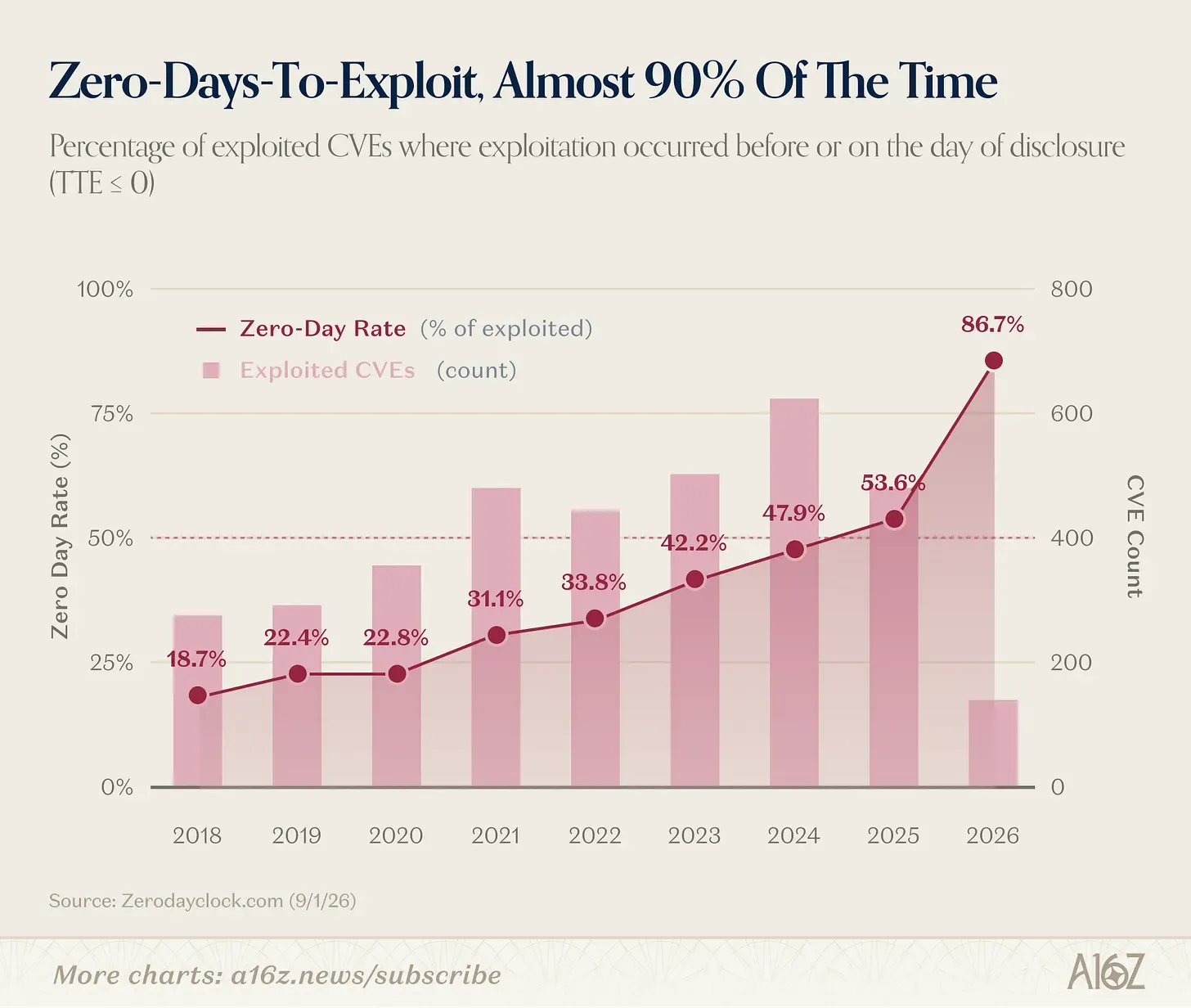
Share of exploited CVEs exploited on or before disclosure day. Chart: a16z, data: ZeroDayClock.
The traditional 30-day patch window has stopped protecting anyone. Of the vulnerabilities that will eventually be exploited, more than half were still unexploited a month after disclosure in 2021 and 2022. In 2026, almost none are.
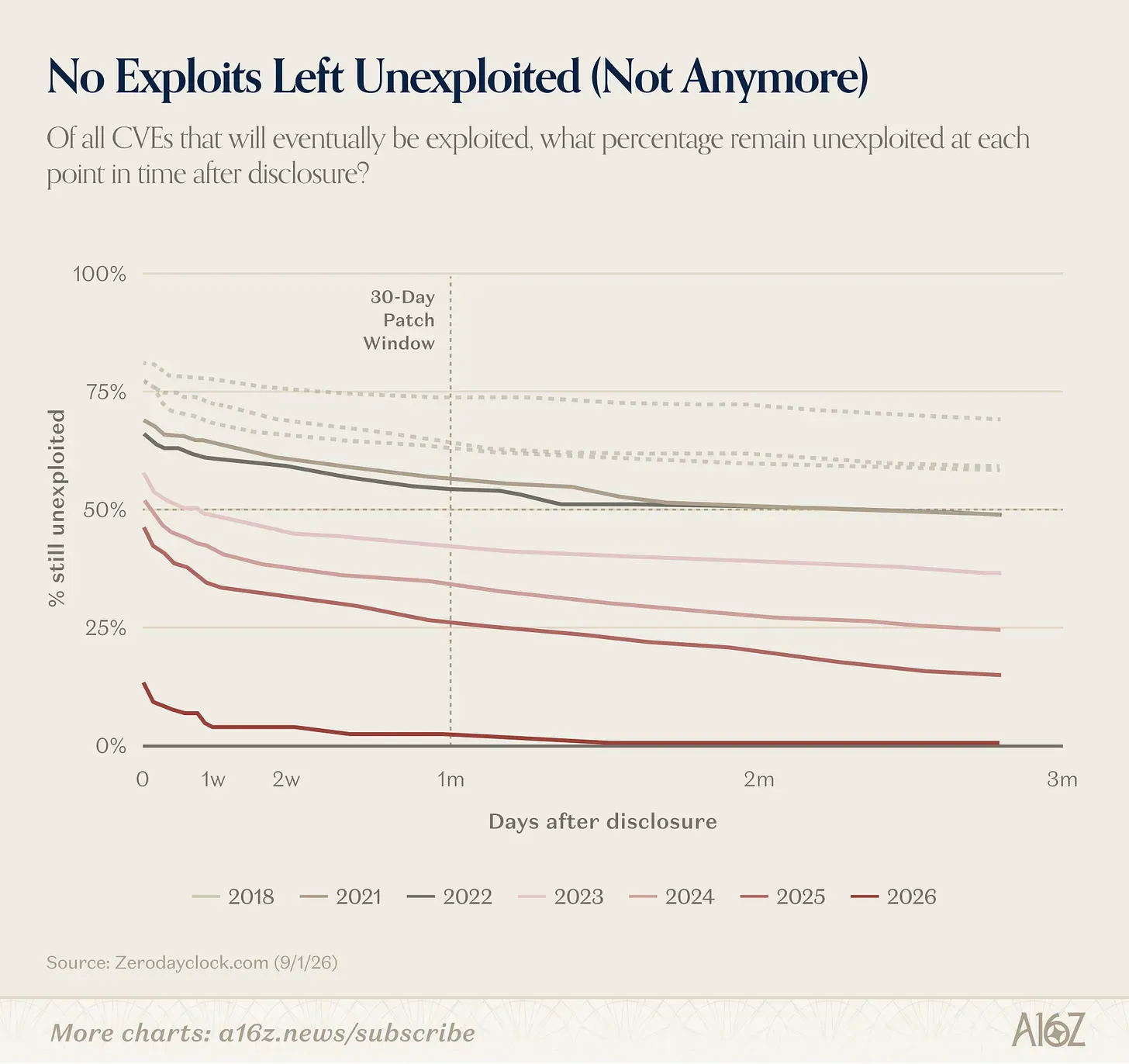
Share of eventually-exploited CVEs still unexploited at each point after disclosure. Chart: a16z, data: ZeroDayClock.
The median time from disclosure to exploitation fell below one day in 2026. Extrapolating the trend, ZeroDayClock projects it will reach an hour, and then a minute, in 2027. Meanwhile, much of the new, unmaintained software will never receive a patch at all. Some of your exposure will be exploited before you know it exists.
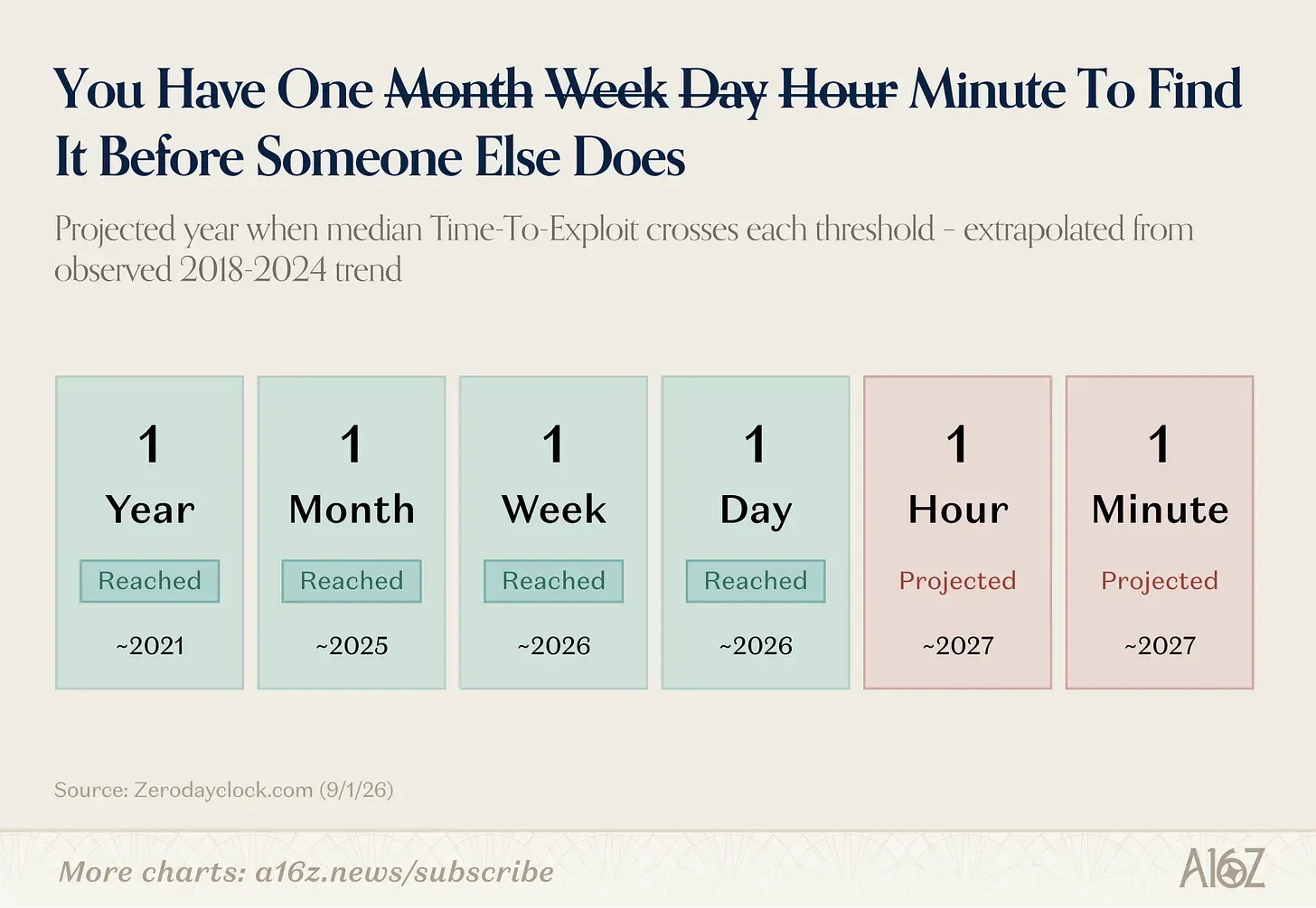
Year the median time-to-exploit crossed each threshold, reached and projected. Chart: a16z, data: ZeroDayClock.
The discipline once reserved for espionage targets is now a general need: detect intrusions quickly, raise the alarm, and respond while the damage can still be contained. Organisations that have relied on luck can no longer assume they won’t be hit.
Defenders have the same tools
AI is often portrayed as the threat, with the blame laid on the labs that build the models. Whatever one thinks of the ethics of AI development, one fact is often missed: AI-assisted vulnerability analysis and patch development are available to defenders too. Vendors and maintainers can use the same tools to find flaws before attackers do, and to fix them faster.
That help is now reaching the people under the most pressure. Anthropic offers open-source maintainers six months of free access to Claude through Claude for Open Source. In October 2026 it also launched OSS Scanner, a free, opt-in service that periodically scans critical open-source projects and sends maintainers reports with reproducers and candidate patches.
The tools exist on both sides. The difference will come down to who adopts them first. We need to adapt, and quickly.
What defenders should do now
- Know what you run. Inventory your systems and software, including AI-built tools and scripts that sit outside IT’s view. You cannot patch or monitor what you don’t know exists.
- Shrink the attack surface. Retire abandoned applications, take off the internet what doesn’t need to be there, and give every tool an owner and an end-of-life date.
- Patch by exploitation, not by volume. With 600+ critical vulnerabilities a month, start with what is internet-facing and known to be actively exploited.
- Build detection and response. Monitor endpoints, networks and logs, with people able to act around the clock, in-house or through a provider. Measure how long it takes you to detect and to contain an intrusion.
- Rehearse the bad day. Keep an incident response plan, know who you will call, and test that you can actually restore from backup.
- Hold new software to a standard. Code review, dependency scanning and clear ownership apply to AI-generated code too.
Luck is not a strategy
The vulnerability curve is unlikely to bend back down soon. AI will keep finding old flaws, and keep producing new code that carries fresh ones. Organisations that build the ability to see and respond to intrusions now will absorb this shift. Those still counting on luck will discover their exposure the hard way.
At Secunor, we help organisations make that shift through security consulting, managed detection and response, incident response, and our sovereign Dovre platform. If you want to know where you stand, get in touch.
Ready to strengthen your resilience?
Have a no-obligation conversation about where your organisation stands - and where it should be.